 Sol Worldwide
Introduction and Context
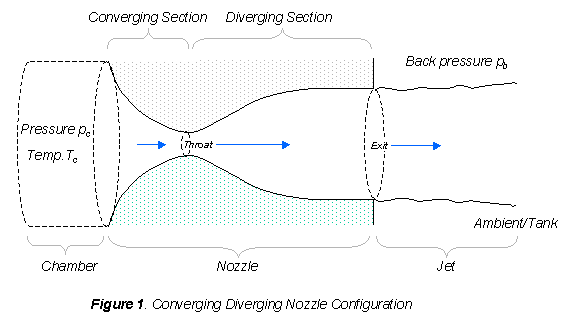
For the entirety of the space age's existence thus far, aerospace agencies and companies have relied entirely on the de Laval bell nozzle design for heavy propulsion onboard operational launch vehicles and spacecraft. The de Laval bell nozzle is a converging-diverging structure engineered specifically to efficiently accelerate high-pressure, high-temperature combustion gases to supersonic velocities, maximizing thrust output. Humanity's expansion in space thus far has been entirely thanks to the bell nozzle design, yet remains fundamentally limited by a thermodynamic and geometric constraint: its fixed expansion area ratio. Because the physical bell nozzle itself cannot dynamically change shape during flight, the expanding exhaust gases can only achieve optimal efficiency at a single, mathematically predetermined design altitude, at which the pressure of the exhaust gases at the nozzle exit perfectly match the atmospheric pressure, resulting in maximized thrust. However, as implied, due to the nature of the bell nozzle, this optimized condition exists at precisely one point in the flight envelope: the moment ambient atmospheric pressure happens to equal the fixed exit pressure of the nozzle.
Below is an example illustration from Virginia Tech:
Prior to reaching space, a launch vehicle must first travel through Earth's dense lower atmosphere. At these lower altitudes, ambient atmospheric pressure is often significantly higher than the bell nozzle's design exit pressure. This results in overexpansion, where the exhaust gases exit the nozzle at a pressure below that of the surrounding atmosphere, causing the atmosphere to compress the exhaust plume inward. The result is a reduced, altitude-inefficient thrust output. Below is an illustration from AerospaceWeb.org depicting three nozzle exhaust conditions in sequence: overexpansion, optimal expansion, and underexpansion.
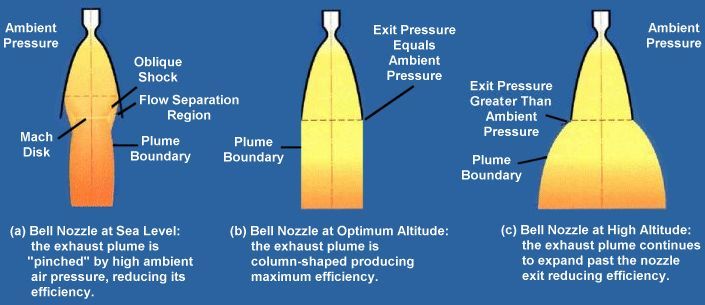
In more extreme cases of overexpansion, a phenomenon known as flow separation occurs, where the smooth flow, or, "stream" of the combustion gases physically detach from the walls of the nozzle, generating violent oblique shock waves and inducing severe asymmetrical flow instabilities, potentially leading to a catastrophic failure. This flow separation usually occurs near the exit of the nozzle, as this is where the expansion ratio is greatest and the local exhaust pressure drops lowest relative to ambient, making it the most vulnerable region to atmospheric compression. Although modern-day bell nozzle rocket engines are designed with this in mind (by limiting the degree of nozzle overexpansion at sea level), overexpansion is still common, and typically a rational choice, as it will, within limits, allow for efficiency to increase as altitude increases within the atmosphere, until the vehicle reaches space.
As a launch vehicle ascends into the upper atmosphere and eventually reaches vacuum, the ambient pressure drops to near zero. In such an environment, the bell nozzle suffers, conversely, from underexpansion: exhaust gases retain significant residual pressure upon exiting the nozzle bell, and consequently expand outward in a wide, radial plume. This is a significant waste of pressure energy that could have otherwise been directed axially to generate additional thrust. To mitigate the issue of sea-level-optimized nozzles being inefficient in the upper atmosphere and in vacuum, and vacuum-optimized nozzles being inefficient in the lower atmosphere, launch vehicles utilize a staging system, with the first stage (often called the booster stage) having engines optimized for sea-level firing, and the second stage having engines optimized for vacuum. Below is an illustration from NASA, showing the distinct first and second stages of SpaceX's Falcon 9 vehicle.

However, designing, building, refining, and maintaining the designs for differently optimized engines adds additional points of failure, as well as significant additional mechanical complexity and thereby manufacturing complexity. The aerospike engine design was introduced to solve the problem of conventional bell nozzles producing thrust inefficiently at every altitude except one.
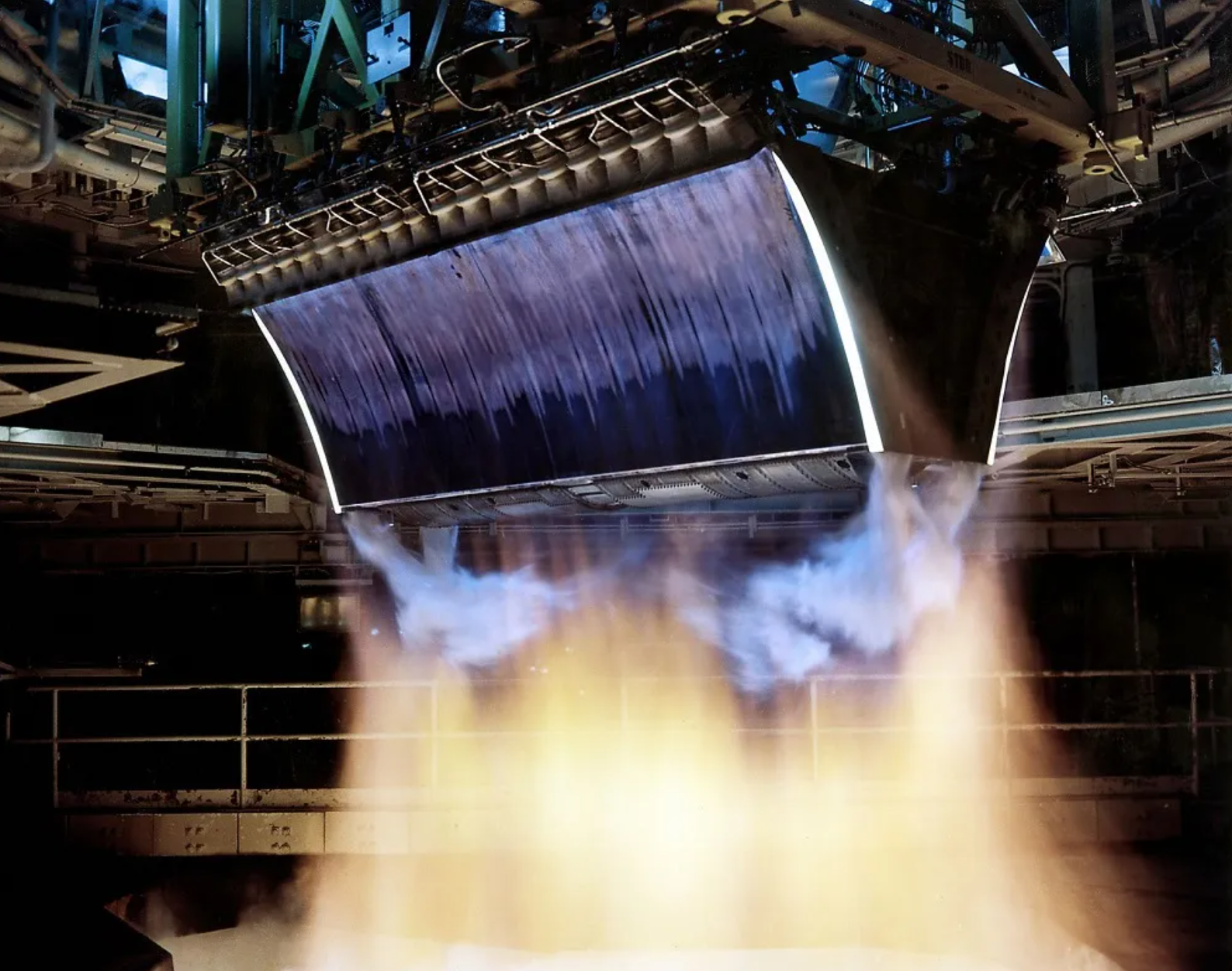
The appeal of aerospike engines is their ability to maintain near-optimal gas expansion across a wide range of altitudes, overcoming, to a large extent, the fixed area-ratio limitation of conventional bell nozzles. Rather than confining the high-velocity exhaust flow from a combustion chamber within a divergent outer wall, the aerospike directs the flow outward against a central geometric spike. The outer boundary of the engine's exhaust plume is therefore left entirely unconstrained by hardware, allowing ambient atmosphere itself to act as an invisible, highly flexible outer wall. This allows the exhaust plume to fluidly adapt to the declining ambient pressure throughout a launch vehicle's ascent from lower atmosphere to upper atmosphere to vacuum. Attached below are images of, in order, a toroidal aerospike (radial design nozzle) and a linear aerospike, the two primary variants of aerospike nozzle designs.

The theoretical result is an altitude-compensating engine nozzle that maintains near-optimal thrust efficiency from the launchpad to the vacuum of space, allowing for a higher specific impulse. Despite these seemingly incredible advantages, aerospike engines, in practice, have historically been limited to theoretical studies, short-term experiments, and ground tests.
The Historic Thermal and Structural Bottleneck Of Aerospike Engines
If the physics of the aerospike design so clearly demonstrate potential to outperform the bell nozzle across a broader range of altitudes, one must analyze why, despite extensive testing by American and European space agencies throughout the 1980s and 1990s, no aerospike engine has ever successfully powered an operational orbital launch vehicle. The failure of spaceflight programs involving aerospike engines, most notably the X-33 program, was due in large part to the fundamental technological limitations of 20th century materials science and manufacturing techniques, and was not primarily caused by the aerospike engines themselves, though the engines were not entirely without their own manufacturing difficulties. In the case of the X-33 specifically, the fatal failure was that of the composite liquid hydrogen fuel tanks, a materials maturity problem entirely separate from the aerospike design. It would seem that in a number of other cases in which aerospike engines were pursued, broader vehicle-level design and engineering challenges ultimately drove project cancellation[1,2] before the aerospike itself could be properly evaluated and tested in practice.
As mentioned earlier, the geometry of the aerospike design subjects its central body to a continuous, extreme heat flux from the surrounding high-temperature gases produced in the combustion chamber. Unlike a bell nozzle, where the expanding, cooling exhaust moves away from the throat, the aerospike's physical structure is continuously exposed to the hottest region of the supersonic plume. Surviving this environment requires a complex and precise network of regenerative cooling channels running close to the surface of the spike, actively pumping cryogenic propellants to prevent the physical spike from undergoing catastrophic metallurgical melting. While advances in technology and manufacturing have reduced the severity of this engineering challenge, it nonetheless remains considerable.
Traditional copper is highly thermally conductive but extremely soft and susceptible to rapid creeping and melting at high temperatures, which is why rocket engines now use advanced alloys, with GRCop-42 representing one of the most significant advances[3] in this domain. By alloying copper with precise ratios of chromium and niobium, NASA engineers created a material that maintains exceptional high-temperature strength, immense creep resistance, and extraordinary thermal conductivity simultaneously. This specific combination makes it an excellent substrate for aerospike centerbodies, allowing it to rapidly transfer heat away from the combustion face and into the cryogenic coolant, helping to address the thermal management problem associated with aerospike centerbodies.
Aerospike Manufacturing In Practice Today
The aerospike ecosystem remains small to this day. With that said, there are a handful of aerospace companies manufacturing aerospike designs for static fire and flight tests.
Pangea Propulsion, a Spanish aerospace startup based in Barcelona, is among the furthest along. In October 2021, Pangea became the first company in the world to successfully fire an aerospike engine using methane and oxygen propellants. The company is now developing ARCOS, a larger, regeneratively-cooled aerospike engine intended for operational, reusable launch vehicles. ARCOS is designed to deliver 750 kN of thrust and is intended for upper-stage use in medium and heavy launch vehicles, with the goal of enabling the re-entry and reuse of upper stages.[4] To avoid the necessity for large numbers of welded components and cooling passages, Pangea uses additive manufacturing[5] to print the engine as a single complex piece, with internal cooling paths already built into the structure. This reduces assembly complexity, weight, and the risk of leaks or weak joints, while still allowing coolant to flow through the hot areas to prevent the engine from melting. ESA has also awarded Pangea a contract to design a very high thrust rocket engine[6], which could power future European heavy and super-heavy launch vehicles.
LEAP 71, a technology company headquartered in Dubai[7], takes a fundamentally different approach to aerospike development, one rooted in what the company calls computational engineering. Rather than relying on human engineers to manually model and iterate on engine geometry, LEAP 71 developed a software system called Noyron[7], which encodes the underlying physics, manufacturing constraints, and engineering logic of rocket engine design directly into an automated computational model. Given a set of performance specifications, Noyron generates a complete, production-ready engine design without human intervention, which is then fabricated via metal additive manufacturing. Using this approach, LEAP 71 designed, built, and hot-fire tested two 20 kN methalox engines in under three weeks[8], a timeline that would be measured in months or years through conventional aerospace development processes. During the aerospike test, the engine reached full chamber pressure at 50 bar and validated the fundamentals of the design, though startup transient issues limited it to a single burn.[8] LEAP 71 has since produced a 200 kN aerospike in collaboration with Shanghai-based manufacturer HBD, printed as a monolithic structure in under 300 hours[9], representing the largest additively manufactured aerospike engine produced to date.
Polaris Spaceplanes, a German aerospace startup based in Bremen, is pursuing aerospike technology as part of a reusable spaceplane design. The company developed the MIRA II, a five-meter unmanned demonstrator aircraft equipped with both conventional jet turbines for takeoff and landing, and a linear aerospike rocket engine for its powered flight phase.[10] On October 29, 2024, over the Baltic Sea, MIRA II became the first vehicle in history to ignite an aerospike engine in flight, firing its LOX/kerosene AS-1 linear aerospike for three seconds and generating 900 newtons of thrust.[11] The work done on MIRA II feeds into the development of AURORA, Polaris's full-scale spaceplane, which is designed for hypersonic flight testing and satellite launch, and is planned to begin operational flights in 2028.[12]
Discussion
The modern aerospike efforts described above would not exist without Rocketdyne. Beginning in the mid-1960s, Rocketdyne conducted an extensive aerospike test program[13], and later produced and test-fired two linear aerospike engines in the early 1970s under a program authorized by NASA's Marshall Space Flight Center[13], accumulating dozens of successful tests across both engines. This foundational work established the core thermodynamic and geometric principles that every aerospike program since has built upon. When Rocketdyne later developed the XRS-2200 for the X-33 in the 1990s, it did so by integrating the aerospike nozzle concept with turbomachinery carried over from the proven J-2S program, deliberately avoiding the need to develop entirely new propulsion subsystems from scratch. The engineering knowledge embedded in that work, covering altitude-compensating nozzle behavior, regenerative cooling of the centerbody, and differential throttling across the ramp, forms the intellectual foundation that companies like Pangea, LEAP 71, and Polaris are now building on.
What has changed is not the underlying physics, but the tooling available to work with it. The thermal and manufacturing barriers that grounded aerospike development throughout the 20th century have been meaningfully reduced by a convergence of advances that did not exist when Rocketdyne was doing this work. Metal additive manufacturing now allows internal cooling channel geometries of a complexity that conventional machining could never produce, and allows an entire engine to be printed as a single monolithic piece rather than assembled from hundreds of individually welded components. Modern computational fluid dynamics and thermal simulation software allow engineers to model exhaust plume behavior and centerbody heat flux at a fidelity that was computationally impossible in the 1990s. Advanced copper alloys like GRCop-42 provide the thermal conductivity of copper alongside high-temperature structural strength that pure copper catastrophically lacks, and raw computing power now makes it possible for a company like LEAP 71 to encode the entire engineering logic of a rocket engine into a software model and iterate on designs in weeks rather than years.
Highest-Potential Future Applications
The aerospike's defining characteristic is altitude compensation across the full flight envelope, from sea-level atmospheric pressure to vacuum. The applications that most fully exploit this are therefore those in which a single propulsion system must perform efficiently across the widest possible range of conditions, with no opportunity to swap engines between stages, or those in which the geometry of the aerospike enables structural integrations that a bell nozzle physically cannot.
Single-Stage-to-Orbit Launch Vehicles
The application that aerospike engines were originally conceived for, and which remains their highest-potential use case, is the single-stage-to-orbit launch vehicle. An SSTO vehicle lifts off from the ground and reaches orbital velocity in a single continuous burn, with no staging events and no hardware discarded. This has never been achieved with a chemical rocket carrying meaningful payload, and a large part of the reason is propulsive: a bell-nozzle-equipped SSTO must choose a single design altitude for its nozzle, accepting severe efficiency penalties during every other phase of its ascent. The aerospike eliminates this penalty by design, maintaining near-optimal expansion from the launchpad through the upper atmosphere and into vacuum across the entire burn. Studies of SSTO design indicate that achieving orbit with meaningful payload requires propulsion systems operating at the theoretical limits of chemical rocket performance, and the aerospike's ability to maintain high specific impulse across varying ambient pressures may provide a critical advantage where conventional nozzle designs fall short. The practical result of successful SSTO flight would be a launch vehicle with the operational simplicity of an aircraft: no recovery of separate booster stages, no refurbishment of multiple vehicle segments, and the potential for dramatically faster turnaround between flights. The aerospike does not make SSTO easy, but it is one of the few propulsion architectures that makes it physically plausible.
Reusable Upper Stages
Upper stage reusability is one of the most economically significant unsolved problems in commercial launch. First stages have been successfully recovered and reflown, most notably by SpaceX, but upper stages present a more difficult challenge: they must operate efficiently in vacuum during ascent, survive atmospheric reentry while descending, and then perform a controlled landing burn back at or near sea level. A bell nozzle optimized for vacuum, where upper stages spend most of their time, produces terrible thrust efficiency at sea level, making the landing burn grossly inefficient. An aerospike, by maintaining useful efficiency across both vacuum and sea-level conditions, is uniquely suited to fulfill all three phases of an upper stage's reuse cycle with a single engine. At least a portion of the aerospike structure can be integrated directly into a heat shield configured to dissipate reentry heat, with active cooling applied to the plug itself, enabling an engine-first reentry geometry that eliminates the need for a separate dedicated thermal protection system. This structural integration, where the engine and the heat shield are the same physical object, is a compelling mass efficiency argument that a conventional bell nozzle cannot replicate.
Horizontal-Takeoff Spaceplanes
The linear aerospike variant is particularly well suited to horizontal-takeoff spaceplane architectures, and this is not a coincidence — the geometry of a linear aerospike allows it to be integrated flat along the underside or spine of a lifting body fuselage, rather than protruding from the rear of a cylindrical vehicle. A primary advantage of the linear aerospike in this context is the ability to provide thrust vector control through differential throttling across the engine's combustion elements, rather than the mechanically complex and mass-intensive approach of gimballing the entire engine. For a spaceplane that must transition from subsonic takeoff through transonic and supersonic regimes to hypersonic flight and eventually vacuum, an altitude-compensating engine that can be embedded into the airframe and steered without gimbals offers genuine structural and operational advantages over any bell-nozzle configuration. This is precisely the architecture Polaris Spaceplanes is pursuing with AURORA, and that NASA pursued with the VentureStar concept decades earlier. The spaceplane application is where the aerospike's combination of altitude compensation, structural integrability, and gimballing-free thrust vectoring all converge simultaneously, making it arguably the single most natural fit for the design.
Mars Ascent Vehicles
The Martian atmosphere is thin but nonetheless exists, as approximately 0.6% of Earth's sea-level pressure, and a Mars ascent vehicle must transition from that low-pressure atmospheric environment through to vacuum in a single burn with no opportunity to stage to a vacuum-optimized engine. This is a flight profile the aerospike handles well. A bell nozzle on a Mars ascent vehicle faces the same fixed expansion ratio problem it faces on Earth, just compressed into a narrower pressure range, while the aerospike passively adapts to whatever ambient pressure it encounters throughout the ascent. The efficiency gains this provides are modest in absolute terms but carry outsized significance in context: on Mars, every kilogram of propellant had to be either transported from Earth at enormous cost, or manufactured in-situ from Martian resources, making propellant efficiency arguably more valuable there than anywhere else in the solar system. In a mission architecture where the mass budget of the ascent vehicle is one of the most constrained and consequential numbers in the entire program, a propulsion system that extracts more performance from the same propellant load has serious practical value.
Conclusion
The aerospike engine is an old idea that was always physically sound, but whose realization required tools that the 20th century largely could not yet provide. Rocketdyne established the foundational engineering knowledge decades ago. The X-33 program demonstrated that the aerospike itself was not the weak link. The thermal and structural barriers that historically made the centerbody an unsolvable engineering problem have been meaningfully reduced by the convergence of metal additive manufacturing, advanced copper alloys, modern computational fluid dynamics, and vastly improved computing power. Companies like Pangea, LEAP 71, and Polaris are actively building and testing hardware today. The applications that stand to benefit most from a mature aerospike, single-stage-to-orbit vehicles, reusable upper stages, and horizontal-takeoff spaceplanes, are very potentially the applications that define the next generation of how humanity accesses space. It would seem reasonable that the outstanding question is no longer whether the aerospike works. It is whether the aerospace industry will commit the sustained investment and flight experience necessary to close the remaining gap between a promising test article and an operational engine. If it does, the aerospike has a credible path to becoming one of the most consequential propulsion developments since the bell nozzle itself.